Before AI Can Transform You, It Needs a Foundation
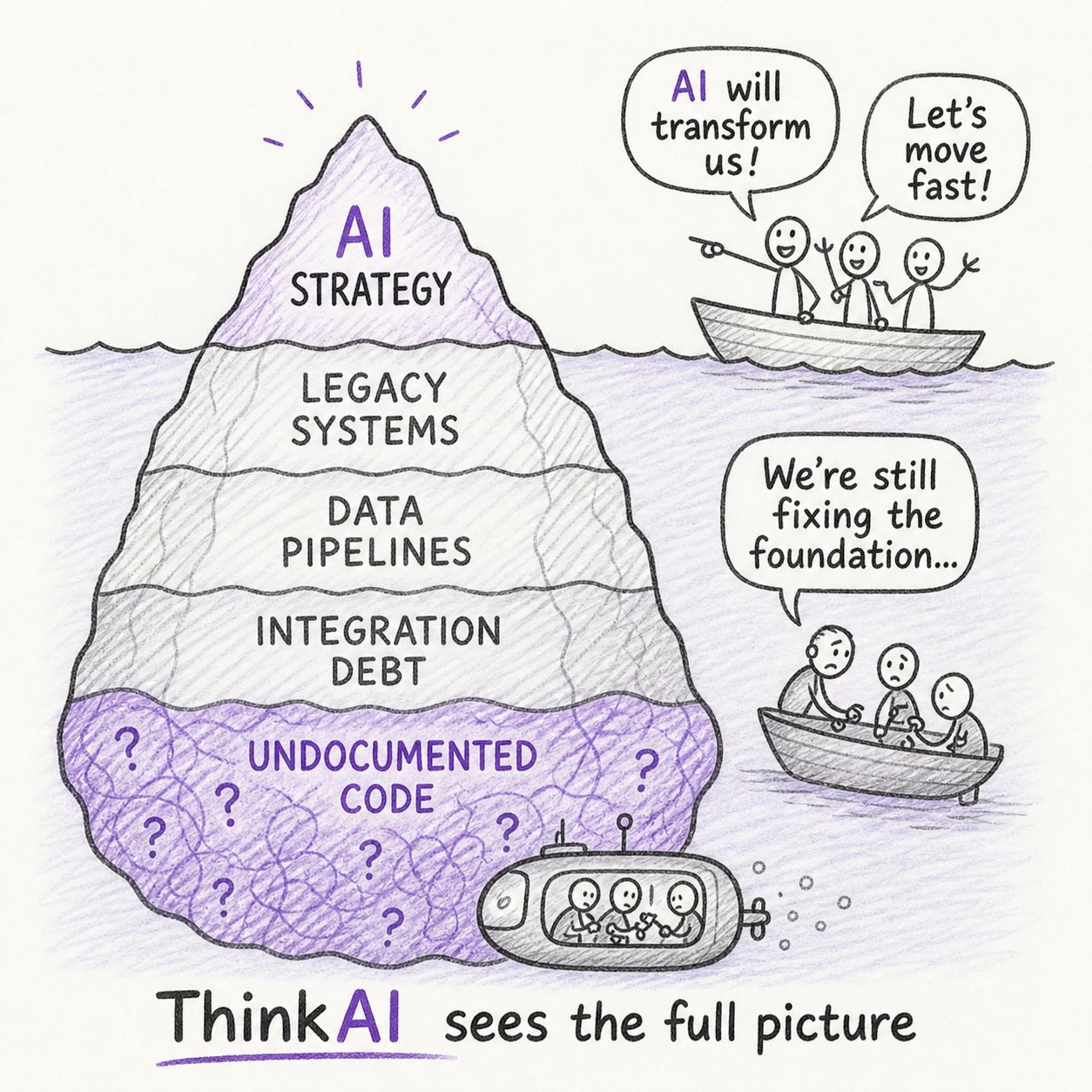
Many companies want to become AI-native, but AI strategy is only the visible part. To fully capitalize on AI, organizations must first address the hidden foundation: legacy systems, data gaps, integration debt, undocumented code, and disconnected delivery workflows.
Before AI Can Transform You, It Needs a Foundation
Every company wants to move fast with AI.
The ambition is clear: improve productivity, accelerate delivery, reduce manual work, and eventually become a more agentic organization.
But becoming agentic does not happen just because a company adopts AI tools.
There is an order to the work.
Before AI can meaningfully transform how a company operates, the company needs to understand what is underneath the surface.
AI strategy is only the visible part
Most AI conversations start at the top of the iceberg.
Leaders define an AI strategy. Teams adopt tools. Pilots are launched. Productivity goals are announced.
This is important, but it is only the visible part.
Underneath that strategy is the real operating environment where AI either succeeds or gets stuck.
That environment includes:
- Legacy systems
- Undocumented code
- Fragmented data pipelines
- Integration debt
- Manual delivery processes
- Inconsistent engineering practices
- Limited visibility into quality, speed, and bottlenecks
If these problems are not understood, AI adoption becomes shallow.
Teams may use AI, but the organization does not become truly AI-enabled.
The first step is visibility
A company cannot become agentic if it does not understand how work actually flows today.
Before scaling AI, organizations need visibility into their current engineering and delivery system.
That means understanding:
- How ideas move from planning to production
- Where teams lose time
- Where quality breaks down
- Which systems are fragile
- Which code areas are poorly understood
- Where dependencies slow delivery
- Which processes are still manual or inconsistent
This step is not glamorous, but it is necessary.
AI can only improve what the organization can see.
The second step is fixing the foundation
Once the hidden blockers are visible, the next step is to strengthen the foundation.
This does not mean stopping all delivery work or rewriting everything.
It means addressing the issues that prevent AI from being useful at scale.
For example:
- Make important systems easier to understand
- Improve documentation where tribal knowledge creates risk
- Clean up critical integration points
- Strengthen data quality and availability
- Standardize engineering workflows
- Improve test coverage and delivery confidence
- Create clearer ownership across systems and teams
Without this foundation, AI becomes another layer on top of complexity.
With the right foundation, AI starts to create real leverage.
The third step is connecting AI to the SDLC
AI should not sit outside the way software is built.
To maximize its value, AI needs to become part of the full software delivery lifecycle:
Plan → Design → Develop → Test → Release → Operate
In planning, AI can help clarify work and identify risks.
In design, it can help teams evaluate tradeoffs and document decisions.
In development, it can support code generation, refactoring, and onboarding.
In testing, it can improve coverage and detect missing scenarios.
In release, it can summarize changes and highlight risk.
In operations, it can help analyze incidents, logs, and recurring issues.
This is when AI starts moving from individual productivity to organizational capability.
The fourth step is governance
As AI becomes more embedded in delivery, governance becomes critical.
Without governance, every team uses AI differently. Standards drift. Quality becomes inconsistent. Leaders lose visibility. Risk increases.
Governance does not mean slowing teams down.
It means creating enough structure so AI can scale safely.
A governed AI operating model includes:
- Clear standards for AI-assisted work
- Visibility into where AI is being used
- Quality checks across AI-generated output
- Security and compliance guardrails
- Measurable delivery outcomes
- Human accountability where it matters
This is how companies move fast without losing control.
The fifth step is measurement
AI adoption should not be measured only by how many people use AI tools.
Usage matters, but it is not the outcome.
The real question is whether AI is improving how the organization delivers.
Companies should measure whether AI is helping teams achieve:
- Faster delivery cycles
- Shorter pull request review times
- Fewer build failures
- Faster recovery from issues
- Better test coverage
- Lower rework
- Improved engineering visibility
- More predictable delivery
- Higher quality releases
This is where AI becomes connected to business value.
A company is not becoming agentic because it has more AI activity.
It is becoming agentic when AI improves the system.
The final step is scaling agentic delivery
Once visibility, foundation, SDLC integration, governance, and measurement are in place, the organization can start moving toward agentic delivery.
This is where AI is no longer used only for isolated tasks.
It begins to support the way teams operate.
Agentic delivery means AI can help:
- Detect bottlenecks
- Recommend next actions
- Support engineering decisions
- Improve planning accuracy
- Strengthen quality gates
- Reduce operational noise
- Connect delivery activity to business outcomes
At this stage, AI is not just helping individuals work faster.
It is helping the organization learn, adapt, and improve continuously.
The order matters
Many companies try to jump straight to AI transformation.
But the order matters.
First, see the full picture.
Then strengthen the foundation.
Then connect AI to the SDLC.
Then govern it.
Then measure it.
Then scale it.
That is how companies move from AI experimentation to real agentic capability.
Final thought
AI can absolutely transform how companies build and operate software.
But AI cannot maximize its impact in an environment full of hidden blockers.
The companies that benefit most from AI will not be the ones that simply move fastest into tools.
They will be the ones that understand the full iceberg, fix the foundation, and then use AI to improve the entire delivery system.
That is how organizations become truly agentic.
Not by adding AI on top of the work.
By changing how the work happens.